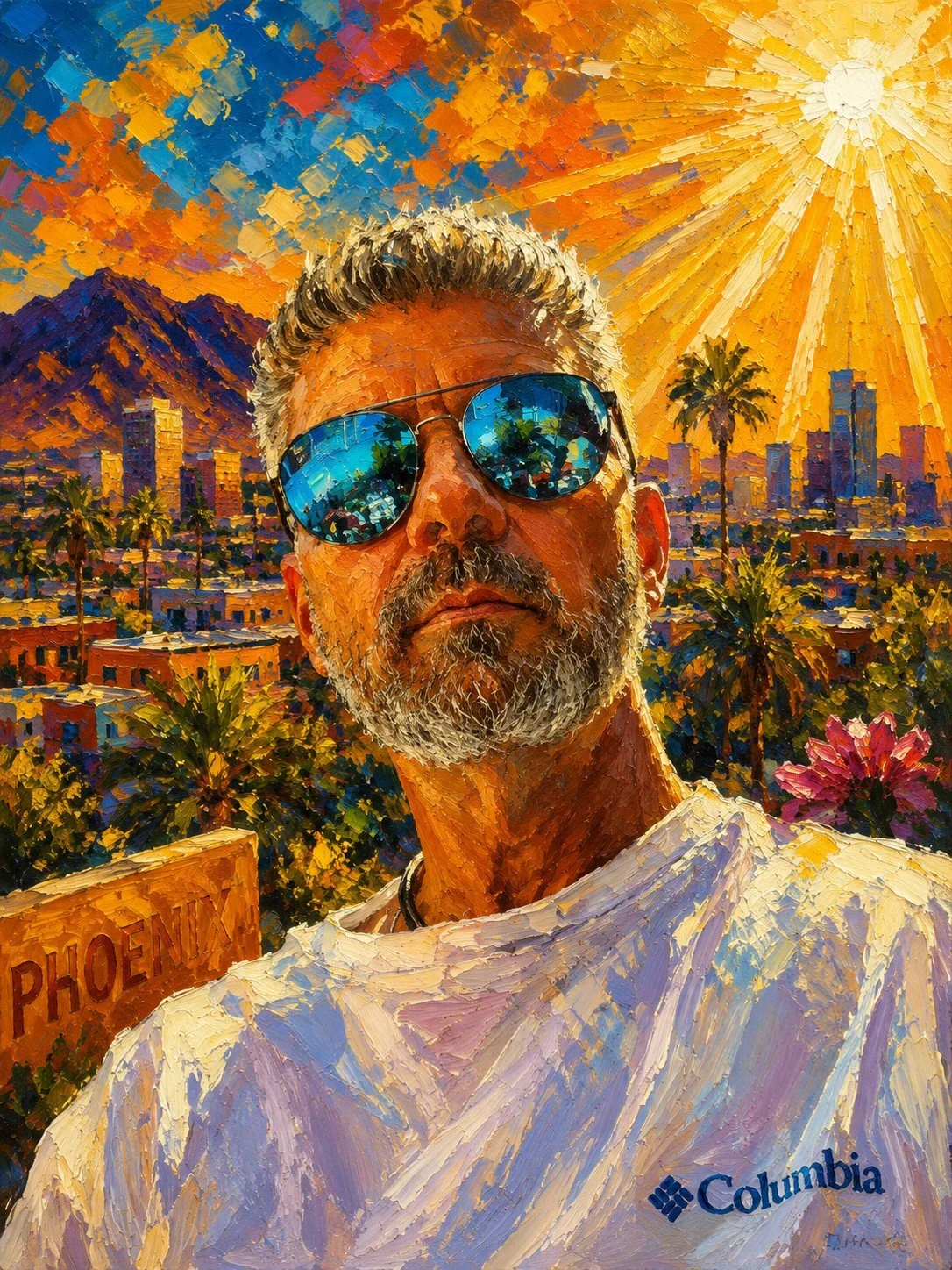
The Day the Music Stopped
I was born on July 25, 1971, in Tifton, Georgia - one of those small Southern towns where the air feels thick with memory and summer, where people measure time by school years, holidays, and who you belong to.
My earliest memories are warm. Not perfect, because nothing ever is, but steady. We ate dinner at the dining table as a family. Summers meant being outside until the sky turned dark. My best friend Andy lived in the house right behind ours, close enough that our childhoods blurred together. We built forts in the woods, rode bikes until we couldn’t see the road anymore, played with Legos and watched cartoons like it was our job.
Saturday mornings were sacred: homemade biscuits and gravy (my favorite), cartoons, and then a whole day that belonged to us. Sometimes it was playing. Sometimes we went into town. Sometimes we visited friends and family or worked in the flower beds with Mama. Even chores felt gentle when she was there.
And Christmas… Christmas was magic, because my mother loved it with her whole heart. Our tradition was to put up the tree on Thanksgiving afternoon. Within days, she’d drape green holly garland on everything, place candles in the windows and on the porch, and turn our living room into something glowing and festive. The big console stereo would blast Bing Crosby, Nat King Cole, and John Denver. But it also played my Muppets Christmas album and my Chipmunks record - over and over - until Mama was tired of it and I was still begging for one more time.
Then came December 1983.
Friday, December 16th was my last day of seventh grade before Christmas break. I was twelve. That night, we went to my dad’s office Christmas party - he was in a wheelchair recovering from knee surgery, so Mama drove. Afterward, we rode around town looking at lights, drifting through neighborhoods where the decorations looked like promises.
On Saturday morning, December 17th, Mama woke me up to see if I wanted to help her make breakfast. I always did. That’s where my love of cooking started - not in recipes, but in being near her, in being included.
When I finally made it to the kitchen, I don’t even know if I said anything. If I did, I don’t remember it. What I do remember is her looking at me, suddenly holding the side of her head, and collapsing onto the floor in front of the stove.
This was before 911 existed in our area. I didn’t know the emergency numbers, so I had to look them up. I called for help. I called my cousin Connie who lived nearby. What was actually said on that call is lost to me, but I remember the way she seemed to appear instantly, as if my voice had pulled her through the air.
My memories of that morning are a blur. Mostly sounds, fragments, flashes - punctuated by a few sharp, permanent images. The paramedics asking questions. My mother not responding. The ambulance leaving. Me ending up at the hospital without any clear memory of how I got there. Begging to see her and being told no. My sister appearing at some point, like a figure in fog.
Eventually they transported my mother from Tift General to Thomasville. On Sunday, December 18th, a doctor asked to speak to the family. I didn’t want to go. I already knew what he was going to say. It was a gray rainy day, and I remember thinking it would never be sunny again.
We buried my mother a few days later.
People came to the house in droves. Food. Flowers. Voices. Condolences that felt like they belonged to someone else’s life. I thought the crowd would never stop, but then it did, and that was almost worse. Because when the last car drove away, the silence stayed. And I was expected to go back to school after the new year and continue living, as if the center of my world hadn’t been ripped out.
From 1984 to 1987, everything changed.
Home stopped feeling safe. It stopped feeling sacred. It stopped feeling like love lived there. My father started dating again within a couple months of burying his wife. He remarried in December 1984, one year after I lost my mother. Family life became something hollow and tense. We didn’t eat dinner together much anymore. There was no steadiness. No warmth. I drifted. My grades dropped. I started getting in trouble at school.
And I found alcohol.
Not at first like a party. Not like rebellion. More like medicine. It was the only thing that made life tolerable. It quieted what I couldn’t name. It softened the ache. It made the world make some sort of sense, even if only temporarily.
In 1987, I got a new family.
My cousin listened to me every day at lunch in high school. Eventually her parents, my aunt and uncle, asked if I wanted to come live with them. I said yes. They came and got me and my things almost immediately.
With them, I returned to something I recognized as family. People cared where I was. Who I was with. They asked about school and tests and homework. We ate dinner together. And I loved it. I still drank, but not the way I had been. It felt like I had a place again.
What I didn’t have was a way to be honest about myself. I knew I was gay. I had no doubt. But I couldn’t say it out loud. I kept a girlfriend in high school like a disguise, because in the world I grew up in, being gay wasn’t just a difference; it was a sentence. When I was a little kid, just starting school, I was called “faggot” by older kids. I didn’t even know what that word meant. When I finally started figuring it out, one of the first lessons I learned was that being who I was wasn’t okay. Family talked about “those people” being evil, and should be avoided. Church said “those people” were an abomination to God, even though their own doctrine says God knew everything from the beginning, so he created me to condemn me. I tried everything I could to not be different. I prayed and begged God to let me not be “that thing” that was so evil. That thing everyone hated. That thing, supposedly, He hated. Instead, I just learned to lie, and pretend, and be a good actor, and just try to be what everyone else said I was supposed to be. And that was such a miserable way to exist.
Still, life moved forward. I earned a full scholarship to Abraham Baldwin College. I made friends easily. I ran for student government my first year and won a seat. I kept a 4.0 GPA. I joined Phi Theta Kappa and later became chapter president and state vice-president. I was elected president of the student union, planning social activities, and I went to San Francisco for our national convention. It was my first glimpse of a world wider than what I’d been handed.
In January 1991, I started Auburn University. I chose Auburn intentionally. Nearly everyone I had grown up with went to the University of Georgia, and I wanted to be my own person. I toured the campus in 1990, attended the Auburn–Georgia game that fall, and watched Auburn beat Georgia so thoroughly that something in me lit up. War Eagle, forever.
I met a guy in my dorm on my second or third day. I am going to call him Luke, because this is my story to tell, not his. We clicked immediately. He became the best friend I ever had, and I fell in love with him with a depth that still stuns me when I look back.
My alcohol consumption went through the roof. I never turned down an invitation. I kept dating girls to keep my cover, but my heart was tied to someone who was also deeply in the closet. We ended up as “roommates” in school. From the outside, I could almost pretend I was living a normal life. From the inside, I was splitting in two.
I graduated from Auburn on June 9, 1993, with a degree in microbiology and chemistry. I drank even during the graduation ceremony. That fact used to feel like a dark joke. Now it feels like evidence: I didn’t just drink to celebrate. I drank to survive.
In December 1993, I started work as a State of Alabama veterinary diagnostic microbiologist in Elba, Alabama. This was my first time living completely on my own. I loved the work. But psychologically, I was not okay. Luke took a job in a different town, about 300 miles away. I missed him so intensely it turned physical. My drinking became constant. I got my first DUI.
I missed Luke, so I drank. I hated being gay, so I drank. I hated living alone, so I drank. I had no friends, so I drank. When I finally made friends, they were bar friends. Drinking buddies. Luke and I spent weekends together whenever we could. Every Sunday afternoon when he left, I would sit by the door and cry. And drink. If I was at his place, I’d postpone leaving as long as possible. Then I’d just drink the whole six-hour drive back to Elba. I’m so thankful now that I never hurt anyone. At least not physically.
I wanted a life with him. I wanted us to step into the light together. He couldn’t. He said he’d never be able to come out to his family. Never even used the word gay. I hadn’t come out either, but I tried to convince him we could do it. He said no. So we stayed a secret for years, seeing each other about once a month, living a relationship that was real and not real at the same time.
Eventually I left that job and moved to Atlanta with friends. I tried to get on at the CDC (for a microbiologist, the CDC is like the dream job), and I would have gotten that job—except by then my drinking was so heavy I missed the call back interview. I traded a future for another afternoon at the bars in Midtown.
But Atlanta offered a new kind of escape: huge alternative bars, loud music, attention. For the first time I felt attractive. Wanted. I mistook that for love. Backstreet Atlanta was enormous. There were levels and dance floors and noise and bodies… and I could stand in the center of it, surrounded by people, and feel just as empty as I did alone. Maybe emptier.
When everything fell apart, as it always eventually did, I moved home to South Georgia briefly, but it was unbearable: hiding my drinking on top of hiding who I was. I hated lying. I hated myself for lying. So I took a job in West Point, Mississippi. I still clung to the hope that Luke would choose me. He never did. The last time I saw him was in the summer of 2000. I left a note saying I couldn’t do it anymore. I cried all the way back to Mississippi. He never reached out again. I never spoke to him again.
I got my second DUI.
Somewhere in those years, I started to realize my drinking was even beyond just abnormal. I would cut back for a few days and notice how good my body felt, and then the depression arrived. The anxiety. The feelings I didn’t know how to survive. So I drank again. I wasn’t ready to call it alcoholism out loud. I didn’t want one more thing “wrong” with me. I already believed I was broken because I was gay. I had been trained and conditioned (brainwashed) to believe that meant I was unlovable, even to God. That nothing in me was good, or worth saving.
I looked at my life and saw a pattern: God took my mother when I was twelve. People left. Relationships faded. Rejection repeated. Alcohol took the pain away, temporarily. It became how I slept. Though it wasn’t sleep. It was collapse.
Before work. During work. Driving anywhere. I couldn’t even go to the grocery store without something to drink. I knew something was bad wrong. I kept going anyway.
In 2000, I moved to Dayton, Ohio for a man. It was terrible from the start. He was controlling, and abusive, and unfaithful. I stayed because I believed I deserved it. Because I was a horrible person. I was one of “those people” that would never deserve better. My drinking burned through five jobs. And now cocaine had joined the party.
I got my third DUI.
In December 2001, my aunt bought me a ticket home. I returned to Tifton, already carrying shame like luggage.
A week after I got back, a friend (an enabler, though I didn’t have that word yet) came to see me. She brought alcohol. We went out. We returned with me completely blitzed, and my family erupted. In the middle of it, in that chaos, I tried to come out (clearly horrible timing, but I don’t think I would have ever done it any other way). I was holding my cousin’s little girl. Someone pulled her from my arms. The yelling continued, and then they all left, literally drove away from the house, leaving me there. Said they wouldn’t allow me to embarrass the family.
My friend packed my things and drove me back to Mississippi. I have not seen that family since.
From 2002 to 2014, I stayed in Mississippi. I waited tables. I helped open a coffee shop and quickly became assistant manager, then general operating manager. I loved the job. I loved all my customers. I loved the owners. I loved being needed. But I was drinking constantly.
The shop opened at 6:00 AM. I had to be there by 5:30. Despite the drinking, I was rarely late. That detail says something about my determination, but it also says something about the grip alcohol had on me: it took alcohol in my system to get me moving. By 2 PM, when my shift ended, I was shaking so badly I could barely function. I’d go to a local restaurant bar, drink until late evening, get a ride home, pass out, and repeat.
After losing my license, I didn’t even try to get it back. I paid for rides. I relied on friends. Toward the end, every cent I had went to alcohol. I fell behind on rent. My house had no power or water because I spent the money on drinking instead of survival. Actually, drinking was survival.
By the end of 2014, alcohol wasn’t working anymore. I was sick if I didn’t drink. Depressed constantly. Terrified. Hopeless. My hands shook so hard I could barely lift a glass. I would sit at the bar each day trying to get the first drink down just to stop my body from revolting. It was no longer pleasure. It was maintenance. It was desperation.
In January 2015, I reached the edge. I had had enough.
I didn’t want to die as much as I wanted the pain to stop. I wanted the fear to stop. The self-loathing. The constant performing. Always giving people the version of me they felt entitled to. I wanted to be free of what my own mind did to me.
I made a choice I can’t romanticize. I left work. I ended up alone in a motel room. I drank. I did what I believed would finally end the agony.
And then something happened that I still can’t reduce to luck.
A friend sensed something was wrong. She retraced my steps. She found the cab driver. She found the motel. She got to my door in time.
I woke up in a hospital bed, restrained, alive, furious about it. I was not grateful. I felt condemned to keep living a life that had been nothing but loss and fear.
But a counselor came. People spoke to me like my life mattered even when I didn’t believe it did. I was admitted for treatment. And somewhere inside the shock and anger, I discovered one unexpected truth:
I felt safe.
No one could get to me there. No one could demand anything of me. I could breathe. I could exist without performing. I also knew another truth: if I walked out with nowhere to go, I would try again. And I knew exactly how to do it the next time. Not because I wanted to die, but because I couldn’t imagine living.
On the last day they could keep me, I filled out discharge paperwork and broke down. I told a nurse I had nowhere to go. That moment is one of the lowest points of my life. Standing at the edge of the world, holding a thin stack of papers like it was an exit plan. In fact, that’s what they called it.
When I walked out the front door, a car was waiting.
A man from the recovery community, someone who had tried to help me before, had come for me. He took me to his home. He put me in a comfortable bedroom. He made sure I had food. And he told me he’d already arranged an appointment at a rehab facility for Monday.
I stayed that weekend under watch, not because I was a criminal, but because I was fragile in the truest sense of the word: not weak, but breakable. I wasn’t going anywhere. I was tired. For the first time in decades, I let myself be held in place by kindness.
That January, I entered a recovery treatment center in Columbus, Mississippi.
I know how it sounds, but it’s the truth: I loved rehab.
I arrived terrified, expecting humiliation, punishment, maybe chaos. Instead, the first night I slept on an industrial mattress with worn sheets and a lumpy pillow and slept better than I had in more than thirty years. The reason was simple: I was safe. A tiny spark of hope, almost invisible, appeared.
At breakfast the next morning, I looked around at the other men lined up: younger, older, my age, black, white, Hispanic, different backgrounds, different stories. And then it hit me with surprising force:
We were all the same.
I wasn’t alone. I wasn’t a freak. I wasn’t uniquely broken. That realization alone felt like oxygen.
I learned the physiology and psychology of addiction. I learned it was a disease, not a moral failure. I learned shame is fuel for relapse. I learned there was help if I would take it, and if I would do the work.
And I did.
I became a leader, partly because I was older and the younger guys listened, partly because I’d survived enough to speak without pretense. I told the truth about where I’d been. I told them I was proud of them for showing up now instead of waiting until they were my age. I told the older ones it wasn’t too late. Hope was not a myth.
When my ninety days ended, I didn’t want to leave. But I transitioned into sober living and built a new life one practical day at a time. I returned to work at the coffee shop part-time and earned trust again. I joined AA. I started sharing pieces of my story. I started leading meetings. I became a house manager.
Eventually, I got my driver’s license back. I became manager at the coffee shop again. I handled payroll. I had a company credit card. I had the capacity to truly show up for the job and the people. Sales boomed. The shop stayed crowded. I learned a new kind of pride: the pride of being reliable, of living in the light.
When the coffee shop was sold and the new owners and I didn’t align, I switched fields. I started at a medical clinic, and within months I was clinic manager. I was rebuilding what I thought I’d destroyed permanently.
And I traveled. It was something I never imagined I’d do again. Manhattan at Christmas in 2017, finally crossing off a bucket-list line by seeing Billy Joel at Madison Square Garden. Then Phoenix.
Phoenix was supposed to be a trip. It became a revelation.
I flew there in 2018 and also saw the Grand Canyon, as if the universe decided to give me a bonus. In early spring 2019 I went to Albuquerque and drove up to Santa Fe, another bucket list destination. My world widened again. My mind started believing in “later” again.
In May 2019, my father died.
The sadness was strange. Our relationship had never been whole after my mother’s death, and by then I’d already mourned the father I needed and didn’t have. As I got older, I could see it differently: when I lost a mother, he lost a wife. Neither of us knew how to navigate that. I was the child, and I believed it was his responsibility to make sure I was okay. I still believe that. But I also believe now that he did the best he could with what he had.
That year I made a decision born of good intentions and bad boundaries: I moved in with a friend who had been sober with me but had relapsed. I thought if we lived together, I could fix him.
We can’t fix people who don’t want to be fixed.
And alcoholism is not something you “beat” and then forget. It waits. It watches. It whispers. It wears a thousand disguises, and one of the most dangerous is pride.
On December 18, 2019, incidentally the anniversary of the day I lost my mother, I took a drink.
That fact still chills me. I didn’t choose that date consciously, but addiction has a way of circling back to old wounds. After the first sip, it was as if a sleeping animal woke up hungry. I bought a case of beer that day. The next day I called out of work. I drove out of town so no one would see me and bought whiskey to mix with fountain drinks. And I drove.
I began drinking at work almost immediately. I was still clinic manager. I was drawing blood. Running lab tests. The lie couldn’t hold. The consequences came. The medical clinic let me go, and my good friend who owned the clinics, someone with a heart of gold, was put in the devastating position of having to release the man she had believed in. I am still sorry for that.
The relapse lasted a year. It wrecked everything: relationships, stability, self-respect. In a strange way it was worse than before, because I had rebuilt a life and burned it down in less than twelve months. But there was one difference that mattered: I knew what happiness tasted like. I knew freedom existed. And I wanted it back.
In 2021, I surrendered fully.
Not bargaining. Not “I’ll cut back.” Not “I’ll do it my way.” Surrender.
On February 20, 2021, I became sober again - this time with urgency, humility, and a deeper desire to safeguard myself. Treatment was different because I was different. I was honest in a way I had never been.
I told my counselor everything.
For the first time in my life, I said the words: I am gay.
And something unexpected happened: my cousins, two of the few family members I had left who still loved me, showed me that the God they serve had room for me, too. Their acceptance gave me courage they will never fully understand.
I faced grief I’d avoided for years. My counselor arranged a kind of service for my father since I hadn’t attended his funeral. She made me write a eulogy. I cried until I thought I would dehydrate. And then I forgave him. Not because he was perfect, but because I was tired of carrying that weight.
I forgave my stepmother. I forgave my aunt and cousins who, I felt, threw me away. I forgave bullies. I forgave the church. I learned a crucial truth: forgiveness doesn’t mean reopening the door. Forgiveness is releasing the burden so it stops poisoning your own bloodstream. It doesn’t deny the hurt. It doesn’t erase injustice. It simply says: I will not live chained to this.
And I learned to keep my ego where it belongs, sealed in the bottom of the last bottle I drank. Not buried so I could pretend it didn’t exist, but visible, so I could remember its power. I don’t have to carry it. But I have to respect it.
After treatment, I lived in recovery apartments with no money and no income, trusting the process and doing my part. I got a job at Starbucks. I discovered I was great in the drive-thru. People told me I sounded like a radio personality, and my early-morning peppiness made them smile. One day my former manager from an eye clinic drove through, recognized me, and asked me to come talk.
She hired me back.
I didn’t have a car, so coworkers ensured I had rides. Then she helped me get into my own townhouse. In December 2021, I spent my first Christmas in my own place, alone, and it was amazing. Not lonely, but peaceful. Proof that solitude could be sanctuary.
I kept working, kept saving. I bought a car. I made amends at the medical clinic and was hired back Saturdays. Somewhere in the middle of rebuilding, I started making fudge for Christmas gifts. Then cupcakes and cookies. With encouragement and a little faith in myself, The Georgia Sweet Shop was born.
Today, I am employed full-time at the eye clinic, where I am now a Certified Optician, and I’m preparing for another certification. I’ve had multiple raises. I still work Saturdays at the medical clinic. The Sweet Shop is going strong. I write and publish books.
I pay my bills. I’m rebuilding my credit. This past June I bought my first brand-new car.
I live in a cozy townhouse with just myself and my moody little cat, whom I love to pieces.
I travel again. I just spent another week in Phoenix this past July. It was my fourth trip to the Valley, and number five is on the books for March.
Phoenix still feels like a promise that will be kept.
I won’t pretend everything is perfect. I still have bouts of depression. I lost my sister several months ago. I miss the desert, and coming back to Mississippi after being out there can feel like grief. I miss the childhood I wasn’t allowed to have. I hate the years I lost to alcohol. I wish I could reclaim the time, undo the choices, erase the damage.
But I can’t.
What I have is today. And a future that is wide open.
I’m not racing anyone. I’ve earned the right to move at my own pace. I know who I am now. I know what I can survive. I know what I can build.
And the people I forgave? All the ones I released from my anger, my obsession, my need for explanation? Well, I’ve recently added myself to that list.
I deserve grace too.
I deserve happiness. And peace.
In my mind, I can see it: mountains, saguaros, hot city streets, and faces that are smiling because they’re alive and still trying. I look out at that horizon, imagined for now, and I feel something I never trusted for most of my life:
Home.
And the best part about knowing where your forever home is - that place your mind and body recognize as belonging - is this:
It can’t be taken from you.
By anyone.
I’ve claimed it. It’s already mine. Not today, and maybe not tomorrow, but I will make it home.
I have possibilities. I have a hope that one day I will know what it feels like to be someone’s favorite person. To walk into a room and have someone light up to see me. I have no idea what that might feel like.
But I think I deserve the chance to find out
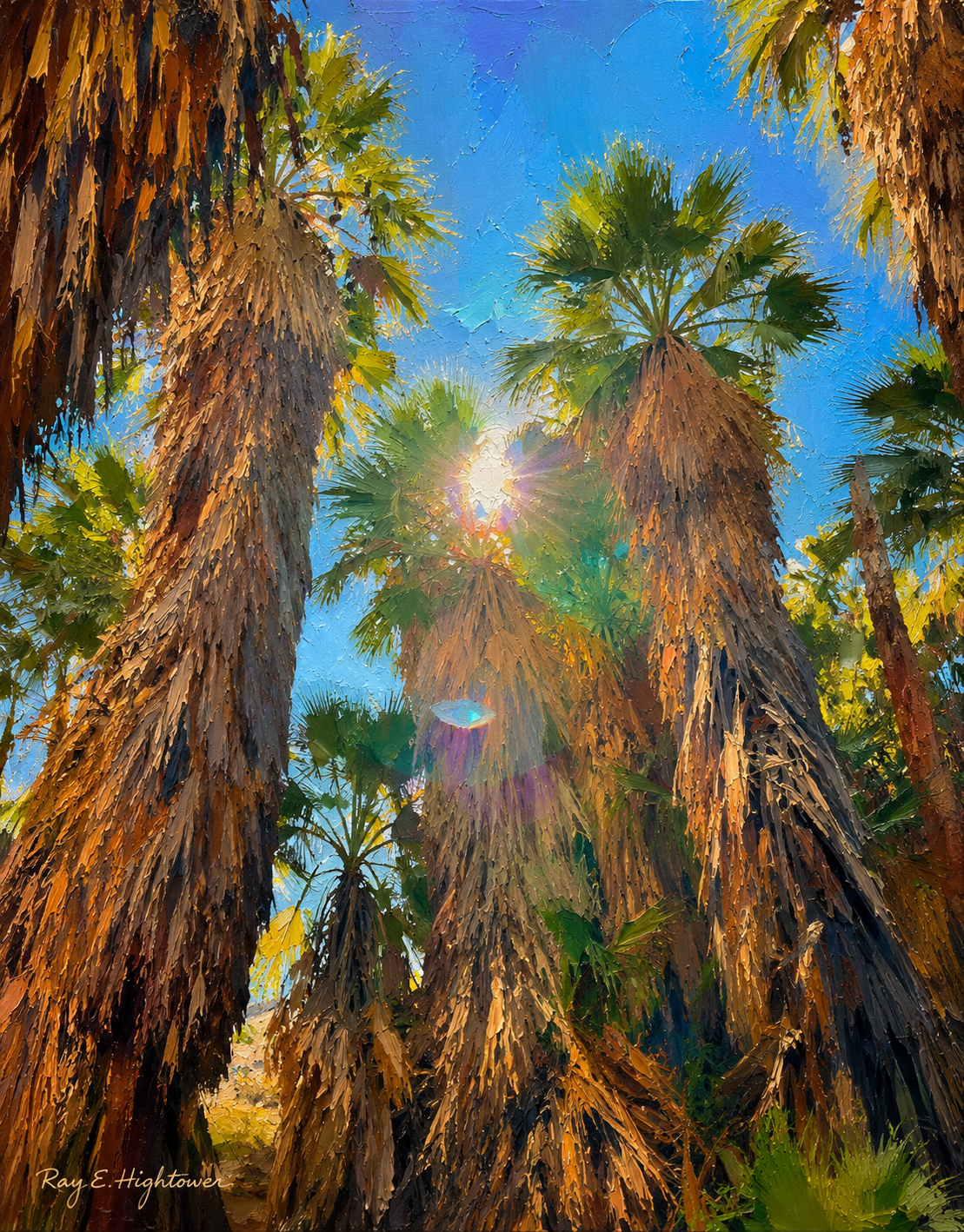
Palm Springs, California
The first thing I noticed about Palm Springs was that it looked exactly like Palm Springs.
That sounds obvious, but I mean it as a compliment.
The city understood its own mythology perfectly. The palms were impossibly tall. The mountains rose dramatically behind immaculate white stucco buildings. Outdoor brunch patios glowed beneath crystal blue skies. Everything appeared sunlit, intentional, and beautifully curated, as though the entire city had decided on an aesthetic decades ago and simply never abandoned it.
And honestly, I admired that.
I had done my homework before arriving. I knew the city’s history as a glamorous desert retreat for celebrities, socialites, and old Hollywood royalty. I knew the visual language. So naturally, I dressed for it. Ralph Lauren. Mirrored Ray-Bans. Silver jewelry and watch. Crisp casual confidence. I looked exactly like the version of myself I imagined Palm Springs would accept.
The funny thing is, I fit rather well. At least visually.
I had brunch at Cheeky's, where the orange juice tasted like someone had just picked the oranges and squeezed them right before I ordered. The breakfast burrito was excellent. The mountains framed the patio perfectly, like they were painted there. It was pretentious in the most delightful way possible. I mean that sincerely.
But as I wandered downtown afterward, something felt slightly out of tune for me personally. Not wrong. Not unpleasant. Just different.
People were polite enough, but distant. Reserved. Sidewalk greetings received brief nods rather than conversation. California courteous. Gallery staff rarely acknowledged me as I entered. The city carried itself with a coolness that seemed carefully cultivated, much like the architecture and landscaping surrounding it.
None of this was necessarily negative. Palm Springs was simply being Palm Springs.
If I am completely honest with myself, I knew that before I arrived. The fact that I prepared my wardrobe like a costume with props proves it. I understood the atmosphere I was stepping into, and I willingly participated in it.
Perhaps I even arrived expecting a certain kind of emotional distance. Years ago, while in New York City, I realized I never encountered the stereotypical rude New Yorker because I never went looking for him. Maybe Palm Springs worked similarly. Maybe I arrived already tuned to notice the polished coolness, the “swimming pools and movie stars” mythology I had absorbed long before I crossed the California state line. So to a point, that’s what became my reality.
After an hour or so, I found myself driving away from downtown toward Indian Canyons.
And something shifted.
At the entrance gate, a smiling woman asked about my hiking experience before recommending trails suited to my comfort level. A ranger along the path warmly offered to answer any questions. A young clerk inside a tiny shop greeted me kindly while I bought cold bottled water.
The warmth felt immediate and unforced.
Then the canyon itself took over the conversation.
The trail narrowed between towering stone walls and enormous native palms that seemed too ancient and too massive to fully belong to the modern world. They looked prehistoric. Water moved softly through the rocks beside the trails. The deeper I walked beneath the canopy, the quieter my mind became.
For long stretches, I saw no one at all.
When I did pass other hikers, we exchanged genuine smiles and sincere greetings. Not the practiced social choreography of curated spaces, but something simpler and more human.
I remember water tumbling recklessly over erosion-polished stone, the sound symphonic. Sunlight filtered through the palm fronds overhead, turning the canopy into stained glass.
The more I immersed myself in it, the canyon seemed beyond prehistoric. It was timeless. A place the world had somehow overlooked in its race to modernize and control. It was surreal.
I could suddenly imagine sitting there alone with nothing but a notebook and pen, writing words no one else would ever read. Somehow, in that setting, the privacy of the act made the words feel even more meaningful. More honest. As though the canyon was enough audience for truth.
That experience helped me better understand something I had already been feeling about Phoenix.
Palm Springs often feels like a beautiful oasis built against the desert. The city softens the harshness around it with elegance, mid-century luxury, and careful presentation.
Phoenix, by contrast, feels like a city existing alongside the desert rather than attempting to replace it.
The mountains remain visible almost everywhere. The heat is acknowledged rather than hidden. The desert still shapes the rhythm of daily life. Nature has not been fully edited out of the urban experience there. Instead, the city seems to breathe with the landscape surrounding it.
Perhaps that is why Phoenix continues to affect me so deeply.
Not because it lacks beauty or sophistication, but because beneath its skyline and museums and rooftop bars, the desert still feels alive.
And maybe that is what I am searching for now more than anything else. Places that allow beauty without requiring performance. Spaces where sunlight reveals rather than conceals. Cities that leave enough room for both humanity and wilderness to coexist beneath the same enormous western sky.
Phoenix burned off my layers of pretension several years ago. I do not want them back.
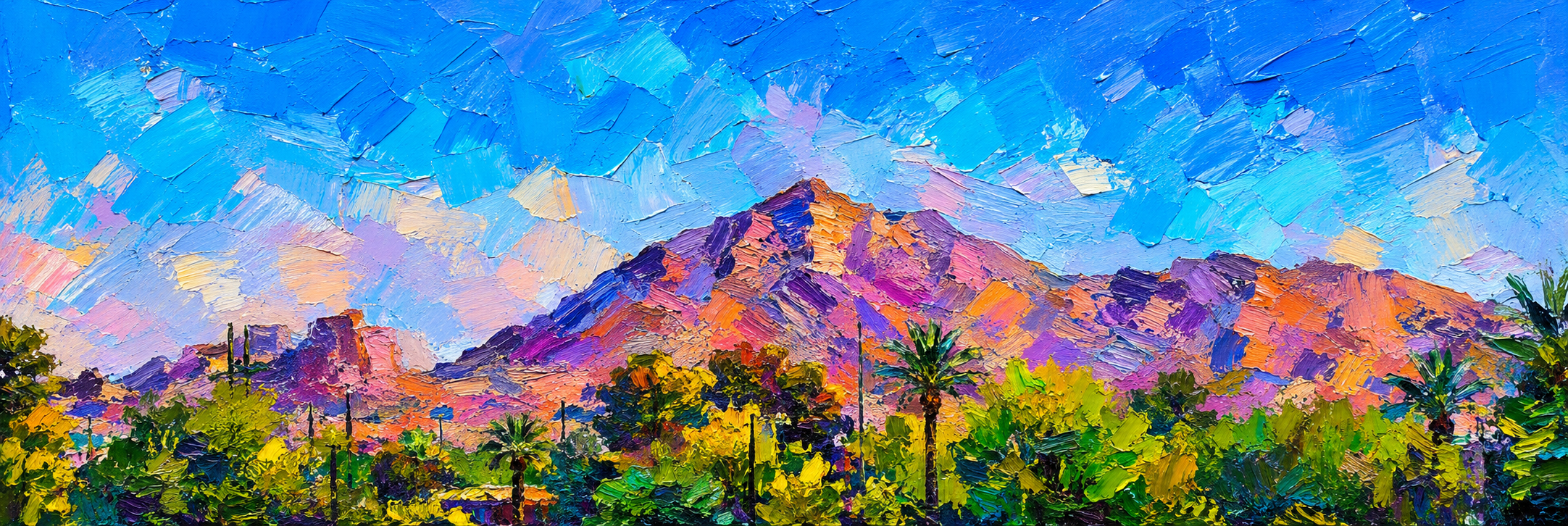
A New Friend
When you fly into Phoenix Sky Harbor, if you’re paying attention, one of the first things you notice is the proximity to downtown. Before you ever leave the airport grounds, the city introduces itself. Riding the train from the terminal to the rental car station, you catch your first ground-level view of the skyline.
And by the standards of New York, Chicago, or even Atlanta, it might initially seem a little underwhelming.
But not to me.
Phoenix does not need towering skyscrapers to announce its presence. In fact, I think that restraint is part of its identity. Other cities introduce themselves vertically. Phoenix introduces itself horizontally.
The tallest building in the Valley, at least for now, is the beautiful 483-foot Chase Tower rising above downtown. In Chicago, a building that size might barely earn a second glance. But Phoenix was never designed to overwhelm from a single downtown corridor. Her personality reveals itself horizon by horizon.
And what horizons they are.
Let your eyes wander in any direction and you begin to understand the true scale of the Valley. Moderate high-rises dot the landscape throughout the metropolitan area. Tempe reaches confidently into the desert sky. Mesa rises quietly to the east. Scottsdale stretches upward just enough to remind you that sophistication and warmth can comfortably coexist. None of it feels crowded. None of it feels desperate for your attention.
Phoenix doesn’t shout.
She expands. She welcomes. She gives you room to breathe.
All areas of the Valley feel like her outstretched arms.
I particularly love downtown Phoenix because it somehow accomplishes something that feels almost impossible for a city of its size. Phoenix itself is home to around 1.7 million people, making it the most populous state capital in America by a considerable margin. And yet downtown feels intimate. Walkable. Human.
The energy there isn’t cold or hurried. It’s warm. And I’m not talking about the desert heat.
The people are some of the kindest I have ever encountered. There is civic pride everywhere you look. The streets are clean. The alleys are clean. Public art appears around corners unexpectedly and constantly, as if the city itself cannot resist self-expression. Like it has a story to tell.
Even the light rail seems to move with the rhythm of the city rather than interrupt it. It glides naturally through downtown, effective and efficient without feeling intrusive. Everything in Phoenix seems to understand balance. Density without suffocation. Growth without chaos. Energy without hostility.
And surrounding all of it are the mountains and the Sonoran Desert, standing quietly watchful in every direction.
That may be my favorite thing about Phoenix. No matter where you are in the Valley, nature is never fully absent. The desert does not surrender itself to the city. Instead, the city seems to exist in respectful conversation with the desert around it.
Even now, whenever I picture Camelback Mountain rising in the distance, I’m not just remembering geography anymore.
I’m remembering a new friend.
And I cannot wait to see her again.
Anticipating the Chase
Last summer, I bought a Diamondbacks T-shirt at Chase Field. At the time, it was just a shirt. A simple souvenir from another visit west. Except it wasn't.
When I bought it, I already knew I would wear it back into that stadium one day.
The crowds were not there yet. The crack of the bat had not echoed across the field. The sharp thwump of a ninety-six-mile-per-hour fastball burying itself in a catcher's mitt hadn’t happened. I had not yet taken my seat.
But all of it already felt real.
I've always struggled to explain what Phoenix represents to me. People often assume it is the sunshine, the skyline, the restaurants, or the desert scenery. Those things certainly matter. But they’re not the reason I keep returning.
Phoenix became important because it taught me to view possibility differently.
For much of my life, the unknown felt threatening. Uncertainty was something to endure. Something to survive until clarity returned.
The desert quietly offered another perspective.
What if the unknown was not something to fear? What if it was something to anticipate? What if uncertainty itself could be beautiful?
That Diamondbacks shirt became a reminder of that lesson.
When I bought it, I didn’t know when I would return. I didn’t know what seat I would have. I didn’t know who would be sitting beside me. I didn’t know what conversations might unfold or what memories might be created.
I only knew there would be another chapter.
Earlier, I wrote that Phoenix is a city filled with friends I haven't met yet. I still believe that. The beauty of possibility is that it leaves room for surprises.
The stranger beside you at a ballgame may remain a stranger forever. Or they may become part of a story you tell years later.
The restaurant you decide to try may become a favorite. Or you may find that the food is too salty, or the salsa too spicy (like that’s possible…).
The conversation you almost didn't have may change the course of your life.
The city you visit on a whim may become the place that teaches you how to breathe again.
Possibility is not certainty. That’s the whole point. It makes no promises. But it keeps the door open. That is why Chase Field was never just a ballpark to me. It was another doorway. Another chapter waiting to be written. Another reminder that some of the best things in life begin long before they happen. Let that sink in for a minute.
Sometimes they begin with nothing more than a T-shirt and the decision to believe that you will return.
In just a few weeks, I'll be inside that stadium. Under that retractable roof. Close enough to home plate to smell the leather on the catcher's mitt. To see, and even feel, the batter's apprehension as he waits for the pitch.
Then the prophecy will be fulfilled.
The unknown will become known.
The possibility will become memory.
And I'll finish this story.
I'll probably write it from a café on Adams Street or Central Avenue, with a cold coffee sweating beside my laptop while the desert sun does what it has always done.
I'll let you know.
Trip Anticipation
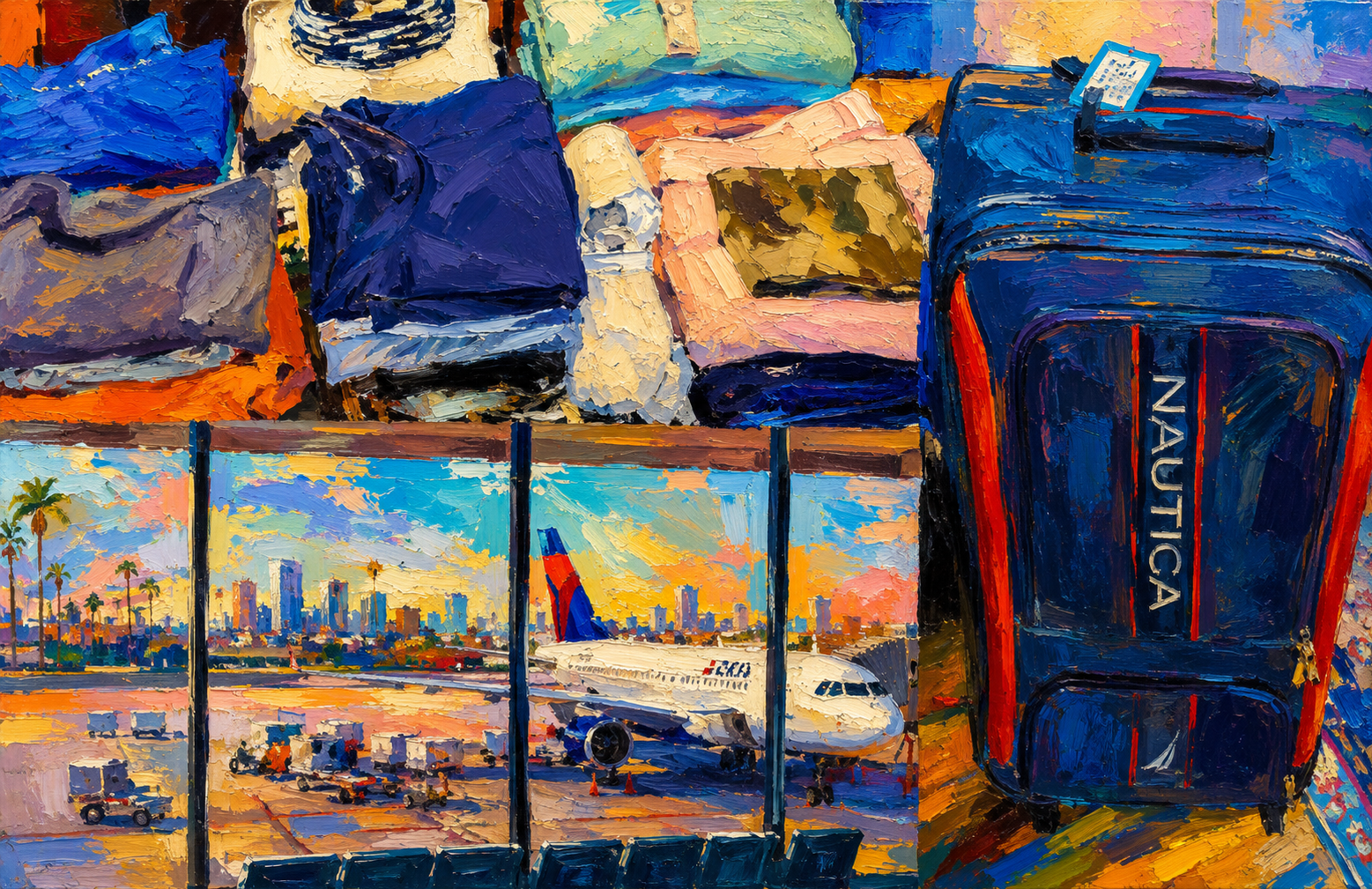
I don’t think the anticipation phase of a trip gets nearly enough recognition.
The actual vacation gets all the attention. The photographs. The restaurant recommendations. The souvenirs. The stories people tell after they return home. But for me, especially before a trip west, the build-up becomes part of the experience itself.
In many ways, it feels almost like an advent season.
For years now, the desert has been the only destination that truly calls to me. Phoenix, especially. Long before airport day arrives, I begin preparing myself mentally and physically for it. I start trying to trim down a little and build up my stamina. Downtown Phoenix is best experienced on foot, at least for me, and the miles add up quickly beneath the relentless desert sun. Museums, gardens, coffee shops, parks, rooftop patios, neighborhood wandering, long evenings downtown. Exhaustion and dehydration can sneak up on you very quickly if you are not prepared.
So the preparation becomes part of the ritual.
I think about outfits weeks in advance. I start mentally pairing shirts and shorts together. I wonder whether I need a new bag. I evaluate the condition of my underwear drawer with a level of seriousness that only experienced travelers fully understand. Little by little, ordinary daily life begins making room for the trip ahead.
The waiting can feel like torture when you are really looking forward to something, so I try to remind myself how quickly the whole thing will just be a memory again. So I enjoy the anticipation. The build-up. I try to enjoy every minute of the entire process.
I rotate my screensavers to photographs from previous trips west. Desert sunsets. Downtown streets. Camelback Mountain standing watch in the distance. I start monitoring the Phoenix weather even though I am still sitting fifteen hundred miles away in Mississippi humidity. I listen to Phoenix radio stations while driving around Columbus as though the Valley were simply a neighboring town.
I write a countdown on my desk calendar at work, starting at the 60-day mark, and ending on airport day. I will start lining up outfits for the trip. Hanging certain groups together. Pairing up shorts and shirts in my closet or in my dresser. When I go in to get out work clothes, I see the little groupings of “trip clothes” and it keeps my excitement up.
This trip I fly out on a Wednesday morning. I will have my checked bag completely packed (but not closed and zipped) by that Sunday afternoon. That gives me two days to walk around it, seeing what’s in it, giving myself time to make changes, deletions, or additions. I will start the toiletries bag, leaving it on the bathroom vanity top, so that I can still use the things I need.
By Tuesday evening, the ritual reaches its final stage. The checked bag gets zipped and placed beside the front door. Final decisions get made about the laptop bag, the sling bag, the clear stadium bag I’ll need for the Diamondbacks game only forty minutes after my plane lands at Sky Harbor. (I’m literally going to hit the ground running.)
At that point, the trip already feels like it has begun.
The main reason for all this is to remind myself that it’s okay to look forward to things. It’s actually important to. But also find ways to live in the moment. Let the pre-trip be an excitement-building phase. Make it part of the whole experience. It makes the waiting more tolerable and ensures that I am well prepared on airport day.
So instead of treating the days before a trip as something to “get through,” I try to make them part of the experience itself.
My time in the desert always goes by much too fast. I’ll use any tactic I can to prolong the experience.
Because looking forward to something beautiful is its own kind of joy.
Open From Seven to Eleven
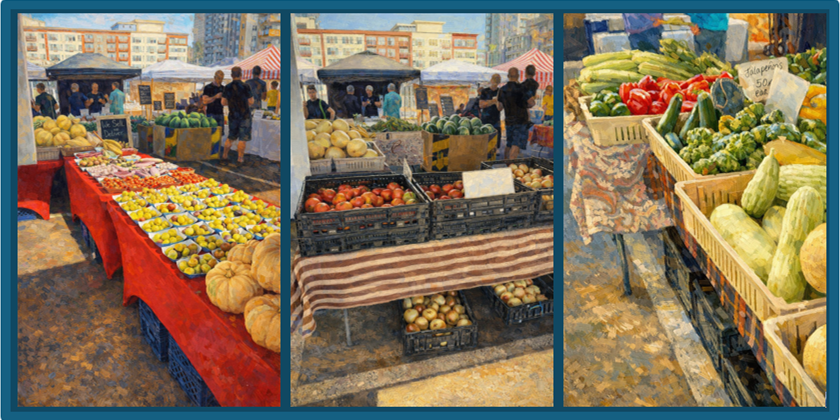
The Downtown Phoenix Farmers Market is open from 7:00 to 11:00 a.m.
Not because someone in an office decided that was convenient.
Because the desert did.
By noon, the sun has already begun pressing her palm against your shoulders. By one, she’s asserting authority. So the market rises early, flourishes briefly, and respectfully folds itself away. No resentment. No complaint. Just alignment.
That was the first thing I loved.
The second was the color.
I have never seen so many peppers in my life. Not just red and green. Crimson. Canary yellow. Sunset orange. Deep purple so dark it was almost black. Pale waxy ones that looked like they had been dipped in morning light. They weren’t arranged for Pinterest. They were simply… there. Abundant. Honest.
Next to them: squash varieties I didn’t know existed. Long, curved, striped, speckled. Armenian cucumbers (what? I had to ask). Melons in sizes from softball to bowling ball. Tomatoes in every imaginable shape — tiny jewels no larger than marbles and heirlooms so large they looked like they needed their own zip code.
Nothing shrink-wrapped. Nothing uniform.
Just life, grown and offered.
Fresh naan was being baked somewhere behind me. The smell drifted through the tents like an invitation. Street burros wrapped in foil. Greek food — actual Greek food — that I apparently love and just never knew because I had never tried it outside of a laminated menu in a strip mall.
And that was the quiet miracle of the morning.
I tried things.
Without suspicion. Without internal debate. Without the tiny Mississippi voice that says, “You won’t like that.”
I ate a vegan donut because it looked beautiful and I felt safe enough to trust the moment. It was soft and perfect and entirely free of the disappointment I expected. Turns out, I don’t need butter to experience joy.
I realized something standing there with powdered sugar on my fingers:
In Phoenix, I am more open.
Maybe it’s the heat. Maybe it’s the light. Maybe it’s the way the city itself refuses to pretend to be anything other than what it is.
Or maybe it’s the people.
Grammy K stood behind her handmade desert botanical soaps like an artist behind a gallery display. She told me about creosote and citrus and oils the way someone talks about family recipes passed down through generations. I bought six bars. Not because I needed soap.
Because I needed proof that real things still exist.
And then — the dogs.
Tiny desert boots protecting tiny desert paws from pavement that demands respect. I laughed out loud. Of course the dogs wear shoes. Of course they do. This is a city that adapts instead of complaining.
And somewhere in between the peppers and the naan and the Armenian cucumbers, I started noticing something else.
Water bottles.
Not disposable bottles of water. Not plastic waste rolling around in a trash bin.
Water bottles. Reusable. Personalized. Covered in stickers. Carried like accessories.
I got more compliments on my “Life Is Good” bottle than on anything else I was wearing. I returned the favor when I saw one I liked — a cactus print, a bold graphic, a minimalist matte black. It was like a quiet handshake between strangers.
Hydration is non-negotiable here. No one debates that. The desert does not negotiate.
So your water bottle becomes part necessity, part identity. It says: I respect this place. I came prepared.
The market was like that too.
Prepared. Intentional. Real.
These weren’t vendors importing sameness. These were growers and bakers and soap-makers and cooks who woke up before sunrise because something inside them demanded to be shared.
And no one lingered past eleven trying to squeeze one more dollar out of the heat.
They honored the rhythm.
I left with jam the color of stained glass. With soap that smelled like desert rain. With the memory of rainbow peppers and warm naan and the realization that apparently I adore Greek food.
But what I really carried home wasn’t in a bag.
It was the feeling of standing in a place where nothing had to exaggerate itself.
The peppers didn’t try to be brighter than they were.
The soap didn’t pretend to be perfume.
The naan didn’t aspire to be anything but bread, warm and generous.
The Greek food didn’t apologize for unfamiliar flavors.
The dogs wore shoes because the pavement demanded it.
The market closed at eleven because the sun said so.
Everything had a reason. Everything had integrity.
And standing there with my water bottle in my hand — sun on my shoulders, strangers complimenting each other’s preparedness like old friends — I realized something quietly powerful:
Nothing there was pretending to be something else.
Neither was I.
A Place to Breathe
When my mother died on December 18, 1983, my childhood ended.
I was twelve years old.
The first Mother’s Day afterward, my sister Carol and I were in a department store together when I told her we needed to buy Momma a card. I said it instinctively, without thinking. For one brief moment, life returned to normal. My brain reached backward into the world as it had once existed and grabbed hold of an ordinary task.
Buy Momma a Mother’s Day card.
I think Carol may have thought I was trying to be funny at first. Maybe cruel in the careless way little brothers sometimes are. But then it hit me.
I remembered.
Not gently, either. It all came back at once. The hospital. The loss. The finality of it. The horrible understanding that there would never again be a card to buy.
Carol had to lead me out of the store because I couldn’t see through the sudden onslaught of tears, and I suddenly couldn’t breathe.
That moment stayed with me for years. Decades, really.
Sometimes grief does that. It waits quietly behind ordinary things. A greeting card aisle. A smell. A song. A holiday. Then suddenly you are no longer standing in the present moment at all. You are twelve years old again, reliving the exact second your world split into Before and After.
I think that’s part of why Phoenix affected me the way it did. Childhood trauma didn’t happen to me there. I’ve never been a drunk there. People didn’t abandon me there. Quite the opposite, really. It was healing, and acceptance. Adoption.
People hear me talk about Phoenix and assume I’m chasing fantasy. But the truth is much smaller and much more human than that.
I don’t dream about luxury high-rises or wealth or becoming someone important.
I dream about peace.
I picture a modest apartment with history in its walls. The kind of place a person slowly transforms into home. I picture early mornings and long workdays and neighbors who know my name. I imagine children in the neighborhood eventually calling me Uncle Ray, or maybe even Tío Ramón - if I’m lucky enough to earn that.
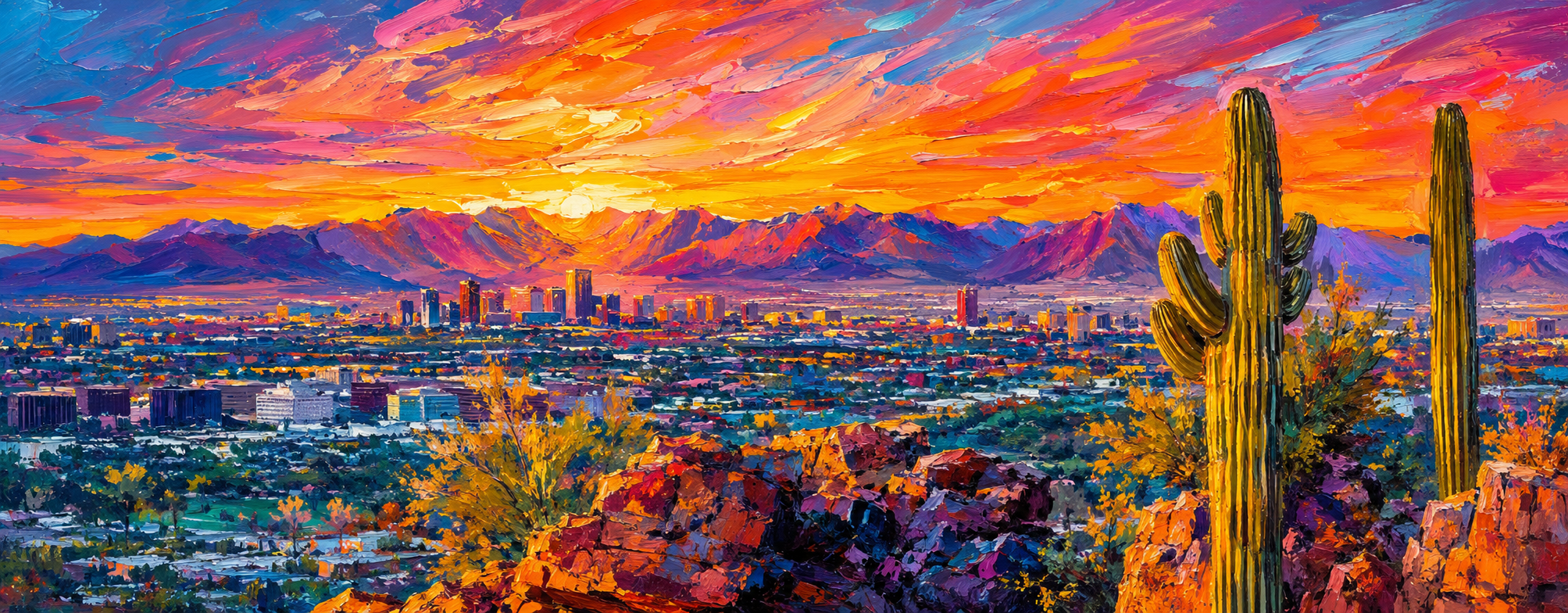
I imagine desert sunsets painting the sky behind the silhouettes of palm trees and mountain ridges. The feeling of light and life and renewed hope. I envision possibility.
I see freedom.
Not freedom from responsibility. Freedom to finally exhale.
Because that’s what the desert gave me the first time I arrived there. Not excitement exactly. Not escape.
Relief. Rest. A sense that it was okay to be broken, and also possible to be healed.
For the first time since childhood, I felt my spirit unclench.
Every time my plane leaves Phoenix Sky Harbor, I feel something I struggle to explain to people. It reminds me of my sister leading me out of that department store all those years ago. That same ache of being pulled away from the place where, for one fleeting moment, everything felt whole again.
But I think I finally understand something now.
Peace is not betrayal, and wanting joy after grief is not abandonment.
And if my mother were here today, she would not tell me to stop dreaming. She would probably already have me packed and halfway to Arizona.
I often picture her there.
Happy.
And somehow, when I picture that version of her standing beneath a desert sunset, smiling because her son finally found a place where he could breathe again, the guilt disappears for a little while.
Maybe that’s what healing actually is.
Not forgetting the people we lost.
Just finally allowing ourselves to keep living after they’re gone.
Arriving at the Edge
I went to the Grand Canyon on Veteran’s Day in 2018.
I drove up from Phoenix early in the morning, before the day had fully decided what it would be. The sun started its slow, deliberate climb as the highway stretched quietly ahead of me. As I got closer, something about the horizon began to feel wrong. Not ominous, just altered. As if the earth ahead had simply… stopped.
The morning light made everything glow in the distance. It wasn’t dramatic in the way postcards promise. It was more subtle than that. The colors and textures were softer. The land didn’t reveal itself all at once. It asked for patience.
When I reached the park gates, a ranger welcomed me warmly and waved me through without charge. It was Veterans Day, he explained. I thanked him, but the weight of that moment didn’t land until later. It wasn’t about saving money. It was about being freely given access - to beauty, to wonder, to something that belonged to all of us because of sacrifices made by people I would never know. The Canyon wasn’t a commodity that morning. It was an inheritance.
As I drove farther in, the landscape surprised me again. Instead of vastness, there was intimacy: a lush pine forest seemed to materialize just inside the gate, closing in around the road, tall, quiet, majestic. The air felt different—older, steadier. And then, without warning, I saw an elk.
It stood close to the road, impossibly enormous and utterly unbothered by my presence. Noble is the only word that fits. It wasn’t there to perform or entertain. It simply was. I stopped, took a few photos, and sat for a moment longer than necessary, as if acknowledging a guardian before proceeding. This was his home.
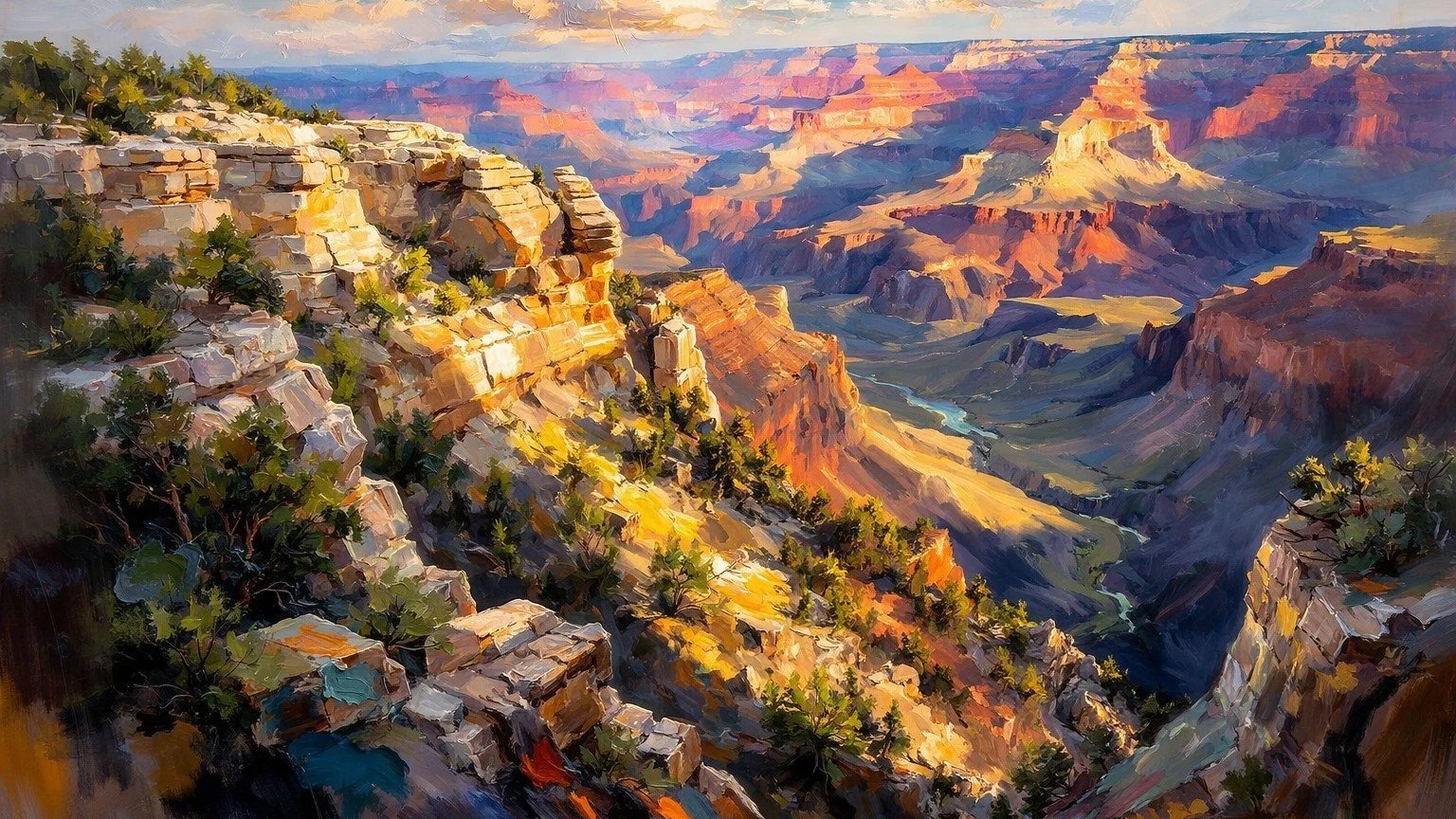
I followed the winding road through this fairytale forest, and eventually parked near the South Rim visitor center and followed the path on foot. Even then, the Canyon withheld itself. The wind was biting and invigorating. Sounds didn’t quite make sense. They were hollow and expectant. I wish I could describe that better, but if you’ve been, then you know. I was nearly at the edge before I finally saw it. The trees simply opened up, like lush green velvet curtains had been drawn back from a stage. And there it was.
I stopped.
There were no other visitors yet. No voices. No footsteps behind me. Just silence, depth, and scale beyond comprehension. I stood at the edge and felt, all at once, impossibly small and completely connected. It was the most spiritual moment of my life.
The Grand Canyon didn’t make me feel insignificant. It made me feel included. As though I were briefly allowed to see my place in something vast and ongoing. I didn’t need to interpret it or explain it. I only needed to witness it. To feel it. To just let it be.
I’ve often thought that if other people had been there, the moment would have been different. Not marred, but definitely altered. Some experiences require solitude to fully arrive. That morning, the absence of a crowd felt intentional, almost generous. In that one instance, I was alone in the presence of grandeur. It was like a moment created just for me.
And I was changed.
Even now, years later, that moment remains intact. It didn’t fade. It didn’t diminish. It became part of me. And I carry with me the quiet gratitude that my being there—on that day, in that way—was made possible by lives lived in service, by sacrifices that extended far beyond that gate.
That morning I didn’t just see the Grand Canyon.
I was reminded that awe, freedom, and beauty are often gifts passed down—waiting patiently for us to arrive early enough, and quietly enough, to receive them.
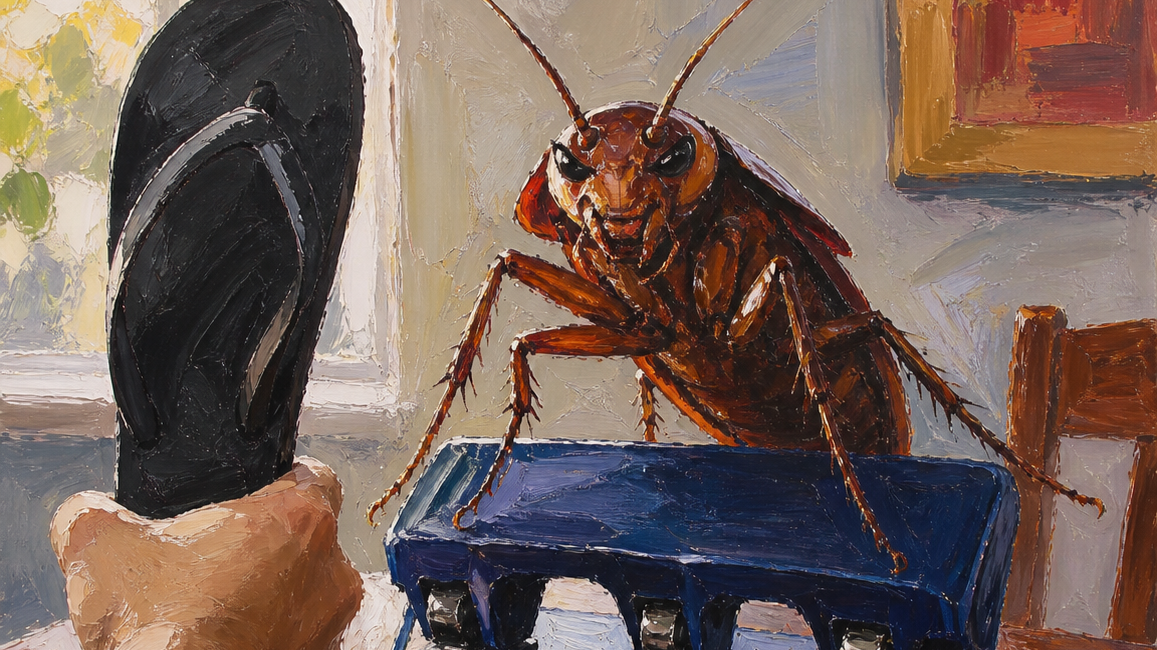
Get Off My Table: A Morning in Three Acts
There is a version of me who believes, deeply and sincerely, that all living things have a right to exist.
This is the version of me who feeds the birds.
Who bakes cornbread for squirrels.
Who gently escorts the occasional wasp back out into the world with the patience of a man who has decided that kindness is not conditional.
That version of me was not present this morning.
Act I: The Discovery
I came downstairs like I do most mornings. Everything was quiet, I was a little reflective, not yet fully assembled as a person. The house was still. The light was soft, just a warm glow in the windows, really. It was shaping up to be the kind of morning that invites gratitude.
And then I saw him.
Perched on my dining table.
On my hole puncher, of all things.
As if he had a meeting scheduled.
Now, in fairness, he was not four feet long.
But I would like the record to show that he was not not four feet long, either.
He was large enough to have presence. Heft. Menace. Large enough to suggest history. The kind of insect that doesn’t feel like an insect so much as a survivor of previous geological eras.
And he was flexing.
Those wings.
Slowly. Deliberately.
I don’t know what he was doing, scientifically speaking. But in that moment, my brain interpreted it very clearly:
He was preparing.
Act II: The Standoff
There is a very specific kind of fear that does not ask for permission before it comes barreling through the gates.
It bypasses logic entirely and goes straight to the body.
My breath caught.
My heart rate spiked.
Every system in me said the same thing at once:
Absolutely not.
I have handled snakes with my bare hands. Even been bitten a few times.
I have stood calmly in the presence of creatures that most people would cross the street to avoid.
But this?
This glossy, unpredictable, wing-flexing intruder had chosen my dining table, in my house, my space, my morning, my peace. Something in me just could not make it make sense
For a moment, we just… looked at each other.
And I’m telling you, he looked back. He absolutely did. And I say he because that was definitely no lady.
He didn’t necessarily look with intelligence. He leered with malice. My brain filled in the rest of the story quickly:
This thing has a plan.
I am in the plan.
This plan must be aborted.
Act III: The Flip Flop
Fear, when it reaches a certain threshold, does something interesting. Typically, it is one of two things:
It either paralyzes you…
or it hands the wheel to something far more decisive.
That’s when my philosophy left the room.
The man who believes in coexistence stepped aside, and in his place stood a much older version of humanity. The one that does not negotiate with unexpected movement on the dining table.
The flip flop came off.
And in that moment, there was no hesitation. No internal debate. No moral framework to consult. I felt like a soldier. Forged in the fires of a primordial and ancient codex that I neither wrote nor controlled.
Only a single, unified objective:
Get. Off. My. Table.
What followed was swift, effective, and, if I’m being honest, more than a little theatrical. (Okay, hysterical, if you must know.)
There may have been a line from an action movie involved. Although I don’t think Bruce Willis delivered it with as much gusto as I did.
There were certainly words my mother would not have approved of.
And then…
Silence.
Aftermath
The house returned to stillness.
The light was just as soft as before.
The morning, in many ways, resumed its original shape.
But something had shifted.
Because here’s the truth:
I still believe that all living things have a right to exist. I really do.
But my dining room table is invitation only.
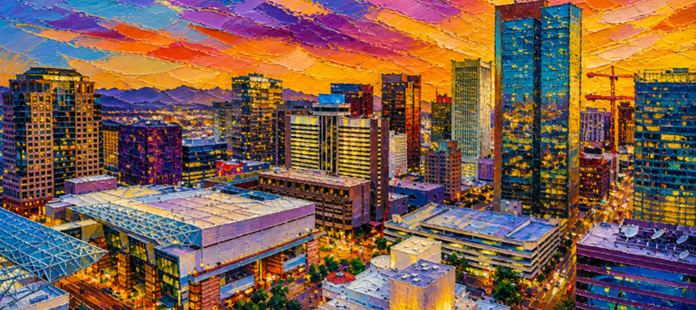
She Doesn’t Shout
New York pulses.
Car horns. Voices. Footsteps striking pavement in quick succession. Sidewalks moving like ant farms. Energy layered on energy. I loved it there. I never encountered the “rude New Yorker” people talk about. Possibly because I didn’t go looking for him. I brought my Southern charm with me, greeted strangers with warmth, and they reflected it back in their own unmistakable way. They even loved my accent.
New York moves fast, but it isn’t cruel. It’s simply alive at full volume. Doing what New York does.
Phoenix breathes differently.
Shouting is not in her nature. She doesn’t need to compete for space or attention. The mountains circle and protect. The sky stretches wide enough for everyone. The desert light does not flicker nervously. It simply settles.
In Phoenix, eye contact isn’t a challenge. It isn’t aggression. It’s recognition. It’s mutual respect. When someone meets your eyes there, they are not measuring you. They are acknowledging you.
And if someone can smile at you when it is 114 degrees, that smile is sincere.
The warm winds comfort and soothe instead of push and jostle. The people are industrious, ambitious, creative, building, forward-thinking. But they also remember to be present. They don’t rush through moments. They inhabit them. They build communities around them.
Phoenix does not apologize for who she is. She is free and open to be herself, and that freedom gives others permission to do the same.
Some cities demand that you keep up.
Phoenix invites you to exhale.
And when you do, you realize she was never shouting. Because she never had to.
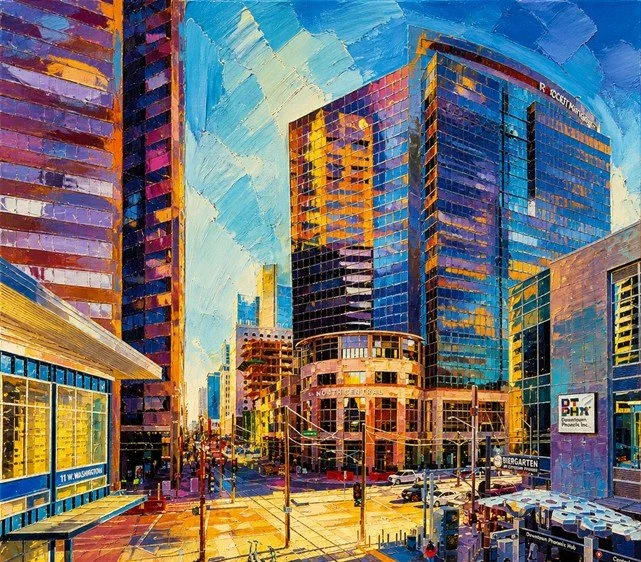
Phoenix, Undiluted
People are often confused when I talk about my love affair with Phoenix. They can’t quite understand how someone could want to pull up roots and move sixteen hundred miles away.
The truth is, my roots here have always been a little shallow. I never built a life around a spouse or children. Both my parents and my only sibling are gone. And the Deep South, as much as I love it, has always carried an undercurrent for me. A quiet reminder of loneliness, of decisions made for me, of a life I sometimes feel like I’ve been watching instead of living.
Phoenix changed that.
Not all at once. Not loudly. She didn’t demand anything from me. She simply… woke me up. Asked me to pay attention. To notice the light, the rhythm, the stillness. To slow down long enough to feel something real and then to trust it.
For the first time in my life, I felt like I was participating.
And there is another layer to it, a layer that is too important to overlook. I spent thirty years of my life in service to alcoholism. And yet, I have never taken a single drink in the Southwest.
Not once.
Every moment I have experienced in Phoenix has been clear. Undiluted. Honest. I have felt everything there exactly as it was meant to be felt. Without numbing it, without softening the edges, without stepping outside of it.
There is something sacred in that.
Because Phoenix didn’t just give me a place to visit. She gave me a place where I could finally show up fully for my own life.
And once you’ve known what it’s like to be fully present in a place that asks nothing of you but your attention, it’s very hard to go back to anything else.
I’ll be in the Valley again in July, for the week of my birthday.
I’m not returning to Phoenix as a visitor this time. I’m showing up as the version of myself that she’s been quietly shaping.
I’m bringing my laptop, my notes, and a small stack of books. Not to sell, but to give, when the moments feel right.
I will know what it’s like to be a writer in Phoenix, which has quietly been the goal all along. Even before I realized it. I am writing toward my current novel’s conclusion, which will have an epilogue set in the Valley. I intend to write that from The Blue Hound downtown.
And if I strike up a conversation with a local while I’m in a café, or coffee shop, or quiet lunch spot (which always happens), I can finally hand them a copy of Phoenix: Permission to Exhale, look them in the eyes, and say:
“I’d love for you to have a copy of this. I actually wrote it for you.”
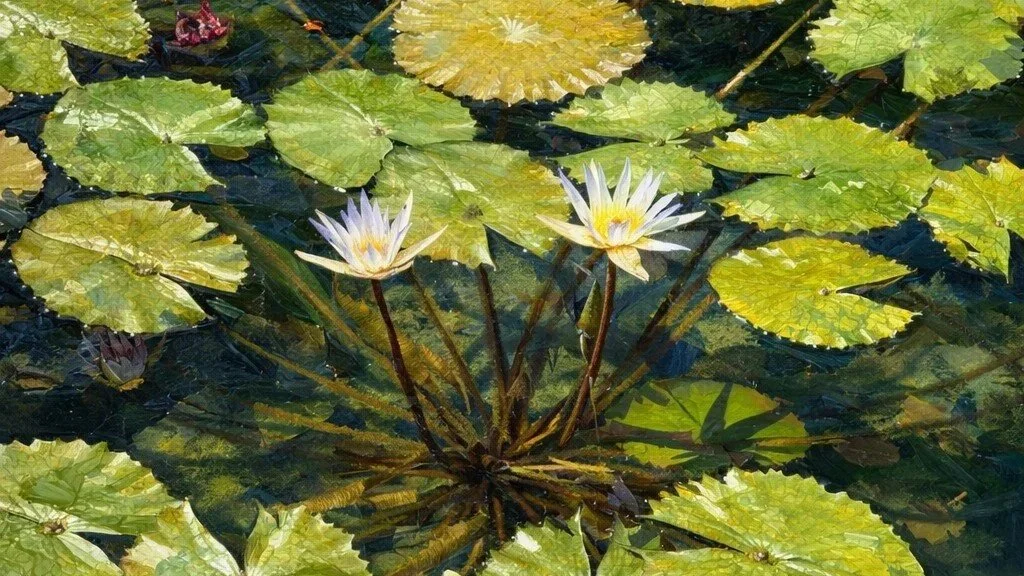
The Japanese Friendship Garden
Phoenix, Arizona
The Japanese Friendship Garden was almost an afterthought. I overheard someone mention it in my hotel lobby and decided to go. I had no agenda set in stone—which is absolutely perfect for Phoenix. I let the city decide what to show me.
I didn’t even take out my journal that morning. I didn’t write a single word. And yet, that experience remains one of my most vivid memories. I can still close my eyes and see the reflective water, feel the hot, light breeze moving across my face. I can see the bright, blood-orange orb of the sun and feel its radiance settling over every part of me. I can even smell the trees. It was a beautiful, welcoming piece of the city—one that asked nothing of me except presence.
As I entered the garden that day, it immediately whispered something into my spirit that I still can’t fully explain. The atmosphere inspired reverence without demanding it. That was simply the vibe. The voice of tumbling water called the songbirds into choir. The koi roiled the surface of still ponds, as if trying to listen. And I stood there, joyfully taking it all in, while the Arizona sun presided over everything.
I sat on a bench for a while, staring at water lilies so vivid they could easily have inspired Monet himself. Smaller fish schooled in the shallows, darting in and out of shadow. Water spilled gently over rocks a few yards away. A duck paddled past. It felt profoundly affirming that a city of 1.6 million people was mindful enough to create—and protect—a space like this. A place that recognized people needed it.
I needed it.
I walked the paths, touched the trees, inhaled the warm, fragrant, healing air. I passed others, and we all smiled, but no one spoke. Words weren’t necessary. I found myself wishing I could know their stories—and wondering whether the garden was whispering the same things to all of us. Shared space. Community, unforced. Presence without pretense.
I didn’t realize how much baggage I had been carrying until this city—this garden, in particular—very kindly, very gently, began to help me hold it. For so long I had been burdened with case after case of insecurity, fear, loneliness, and doubt that the weight simply felt like part of me. But the intense, inspiring sun began to lighten them. Then the warm desert breeze slowly swept them away.
More freedom.
I hope that everyone fortunate enough to visit this literal urban oasis will leave their worries outside the gates. And the ones you feel you must carry in with you? Give this sacred space permission to take them. Allow it to fill you with the strength to let them go.
A Personal Philosophy
I believe life reveals itself slowly, and only to those willing to arrive without noise.
Some of the most important moments do not announce themselves, they wait at the edge of forests, in the hush before crowds arrive, in the space between longing and belonging.
I believe place matters.
Not as geography, but as relationship. Certain landscapes recognize us. They mirror parts of ourselves we did not then have language for. When I say a place feels like home, I mean it has accepted me without asking me to be smaller, quieter, or different than I am.
I believe solitude is not loneliness, but clarity.
There are experiences meant to be witnessed alone. Not because others would diminish them, but because silence completes them. Awe needs room. Meaning needs space.
I believe humility and connection can coexist.
Standing before something vast does not make me feel insignificant; it makes me feel included. I am small, yes, but I am not separate. I am a note in a larger composition, necessary not because I dominate, but because I exist.
I believe healing is not a return to who we were, but an arrival at who we are becoming.
Recovery, growth, and reinvention are acts of courage. They are quiet rebellions against disappearance.
I believe moments are sacred when we honor them fully, and immortal when we write them down.
Memory fades. Language endures. When I give my experiences words, I allow them to live beyond me, to belong to others, to become part of a shared human inheritance.
And I believe that when my time in this body ends, nothing of value is lost.
The stories remain. The echoes remain. The love remains. I will not vanish. I will rejoin the symphony that was always playing, even before I knew how to listen.
Southwestern Hospitality
A City That Notices
I absolutely love Southwestern hospitality.
It goes far above and beyond what Southern hospitality does, at least in my experience. The Deep South has largely lost its come in and sit, you’re welcome here spirit. That warmth now feels conditional. You have to earn it. Outsiders are scrutinized.
The Southwest takes ownership of hospitality and openness, and does so effortlessly. It’s just who they are.
Too often, Southern hospitality comes with an unspoken addendum: Come in and sit with us, if you’re like us. And think like us. And worship like us. The welcome narrows quickly. The Southwest has none of those barriers.
I learned that before I even had language for it.
On my very first trip in November of 2018, I visited the Desert Botanical Garden. I walked up to the ticket window, reached for my wallet, and before I could say a word, a local stepped forward, handed the attendant a card, and paid for my admission. Just like that.
No explanation. No small talk. No expectation.
I thanked them, startled and unsure what to say. They smiled warmly, casually, and then walked away.
There was no performance in it. No speech about kindness. No attempt to be remembered. Just a quiet, instinctive generosity extended to a stranger.
I didn’t understand it fully at the time. I just felt it.
Now I do.
Here, the invitation feels different: Come on in. Tell me about yourself. Not in exhaustive detail, but just enough to begin. Not because curiosity is limited, but because connection doesn’t require a résumé. There are no wrong answers.
The Downtown Phoenix Ambassadors embody this spirit better than any civic program I’ve ever encountered. Their presence alone reveals the heart of the city. Never once did I feel the oh God, another clueless out-of-towner vibe. Instead, they approached me as if I were already known—offering a simple hello, asking how my day was going, or whether I needed anything. That, to me, is so Phoenix.
I try my best to move through the city like a local. I’m close, but I’m not quite there yet. I know I sometimes carry that brief, inquisitive pause: the moment you linger at an intersection, reread a street sign, or hesitate at an escalator to be sure you’re in the right place. They notice every cue. And they always come to the rescue.
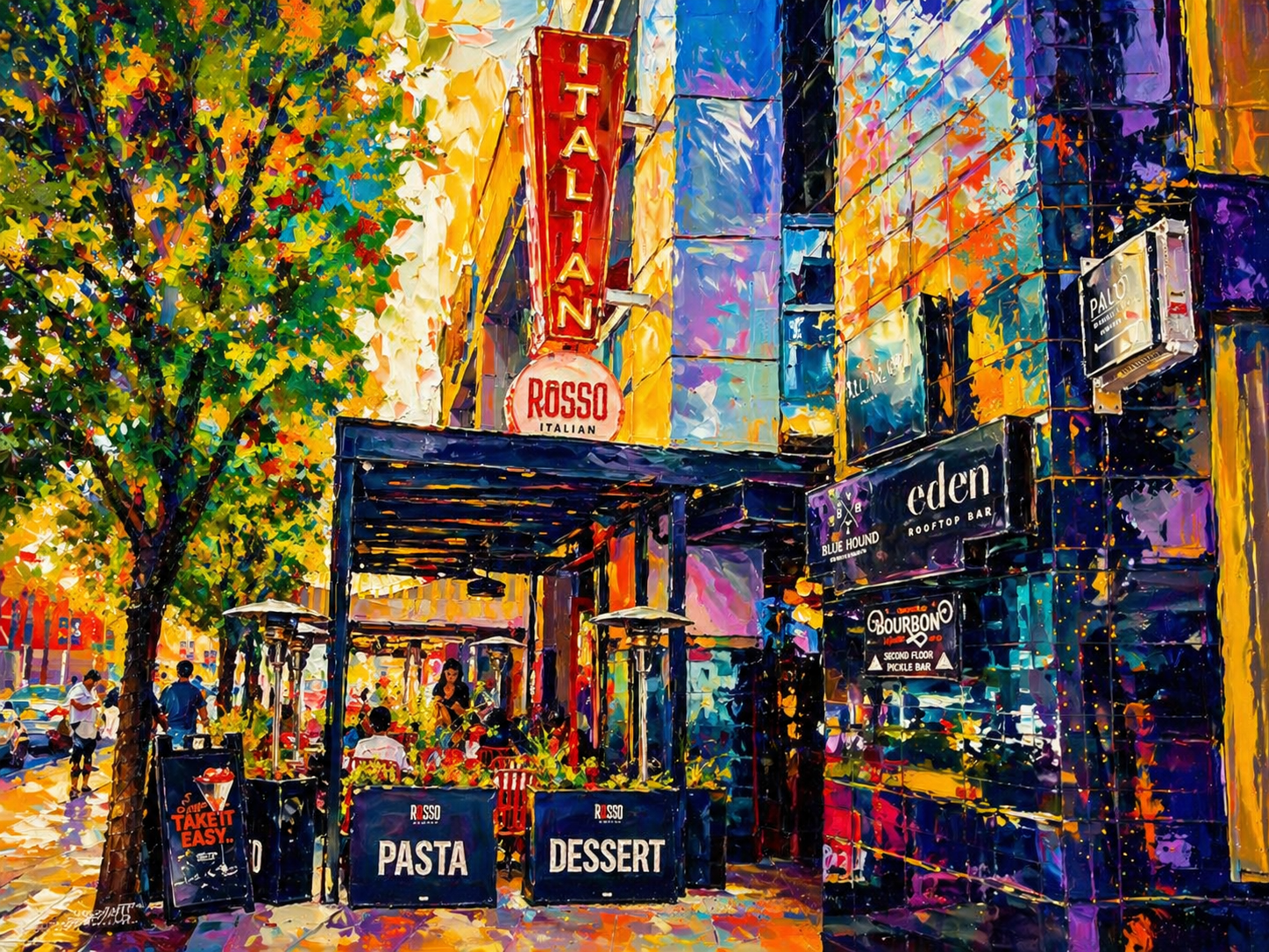
Last July was my first time staying right in the middle of downtown. On my first day, I had lunch reservations at Rosso Italian. I went straight from the airport to Hyatt Place, dropped my bags, and headed out, hungry and jet-lagged. It was 2:00 p.m. in the Valley, but my stomach was still on East Coast time.
I walked confidently to where I thought the restaurant was. Except I didn’t. I walked to where I assumed it was. I was close. Very close. In fact I walked right past it several times before an Ambassador gently intervened.
He was kind and welcoming. He didn’t just point me in the right direction, he actually walked with me. Along the way, we talked about my plans for the week, and he offered tips and suggestions. Nothing felt rushed or rehearsed. When he left me at the restaurant, he said to let any of them know if I needed anything at all while I was there.
And I knew he meant it.
You could tell he wasn’t working for a paycheck. He was working because he loved people, and Phoenix, and being of service. I still wish I had invited him in to have lunch with me.
Long before I understood it, this city had already shown me who it was.
It noticed me.
And it welcomed me in.
Permanence
I’ve spent my whole life saying goodbye.
Learning how to let go of things I wasn’t allowed to keep.
What does it feel like when someone stays?
When something gains permanence?
When you become someone’s first choice?
My mother was yanked from my life when I was only twelve.
Abruptly.
There was no preamble, no omen, no foreshadowing. Just finality.
There was no negotiating period, no bargaining, no counter offers. No choice.
My dad went next. Not physically, at first. He was taken away by grief he couldn’t process.
It seems we buried key parts of him along with his wife.
He remained my father, but I lost the part of him that remembered how to be a daddy.
That summed up my life for a lot of years.
After a while, I stopped asking people to stay.
I became highly skilled at anticipating exits.
I kept one hand on the doorknob of every relationship, every city, every dream.
Calling it resilience.
Sometimes it was. Mostly it was fear dressed up as survival.
I am still learning that not everything I love is destined to disappear.
It’s still true that some things leave.
Some things die.
Some things are taken.
But perhaps a few things are meant to remain.
Maybe that’s what I’ve been walking toward all along.
These days, I find myself drawn to places that feel steady.
Sunlight that arrives on schedule.
Familiar streets.
Coffee shops where no one asks me to be anyone other than myself.
I think I am still searching for proof that permanence exists.
Or maybe I’m finally building it.
In the Staging Area
Most people talk about the Hartsfield–Atlanta Airport as though they survived it.
And I understand why.
It’s loud. Massive. Constantly moving. There are children crying, boarding groups being announced, suitcases clipping unsuspecting ankles, and at least one person every hour who appears to believe they can outrun time itself. If you’ve ever found yourself racing through Concourse B while carrying your sanity in one hand and an overpriced sandwich in the other, I understand your frustration.
But I’ve never feared that airport.
I thrive there.
In fact, I’ve spent more time than I care to admit happily planted in one of its public seating areas with a backpack at my feet, a snack in one hand, a drink in the other, completely entertained by the rhythm unfolding around me. Families reunite. Business travelers speed walk past me with expressions that suggest world peace may depend on how quickly they get to their departure gate. Pilots move with calm precision. Gate agents somehow maintain order in what often looks like beautifully organized chaos.
And honestly? The food and drinks are still cheaper than at most movie theaters these days, so I consider the whole thing a bargain. It’s dinner and a show.
What most people see as stress, I see as choreography.
Above ground, it can feel chaotic. Beneath the surface (quite literally) there is structure. The Plane Train moves people with remarkable efficiency. Bags disappear into unseen tunnels and somehow reappear exactly where they are supposed to be. Thousands of employees work behind the scenes in roles most travelers will never notice. There is repetition. Infrastructure. Connectivity. Stability.
Precision.
That place works because so much is happening that most of us will never see.
And lately, that feels a lot like my own life.
On the surface, I probably look like I’m being pulled in ten directions at once. There are books to write. A website to build. blog posts to publish. work responsibilities to manage. health goals I’ve committed to. future plans quietly taking shape. Dreams that feel both very close and very far away depending on the day.
There are moments when even I look at my own life and wonder how all of these moving parts are supposed to come together.
But beneath the visible chaos, I’ve been building systems.
Sobriety gave me structure.
Discipline gave me consistency.
Writing gave me purpose.
Faith gave me patience.
And maybe most importantly, life has taught me how to move forward even when I can’t see the full map.
When I’m standing on the Plane Train and there isn’t a seat available, I always do the same thing.
I lean in the direction I’m headed.
It sounds small, but it has become instinct. I plant my feet and lean forward toward where I know I’m going instead of backward toward where I’ve already been. I grab a rail or a strap for balance—not because I’m weak, but because I understand that confidence and support can exist in the same moment.
I know where I’m going.
I also know none of us get there completely alone.
That tiny act has become an accidental philosophy for how I live now.
Lean toward what’s next.
Hold on when you need to.
Trust the infrastructure you’ve built.
And understand that not everything meaningful is visible from where you’re standing.
These days, my life can feel as hectic as the Atlanta airport on a holiday weekend. From the surface, it may look messy. Loud. Uncertain.
But I’ve learned not to panic when I can’t see every moving piece.
Some things are being handled beneath the surface.
Some doors are opening that I cannot see yet.
Some baggage is being routed exactly where it needs to go.
Some connections are still being made.
And when I finally arrive at the life I’ve been working toward, I believe something with my whole heart:
Everything I am supposed to have will arrive when I do.
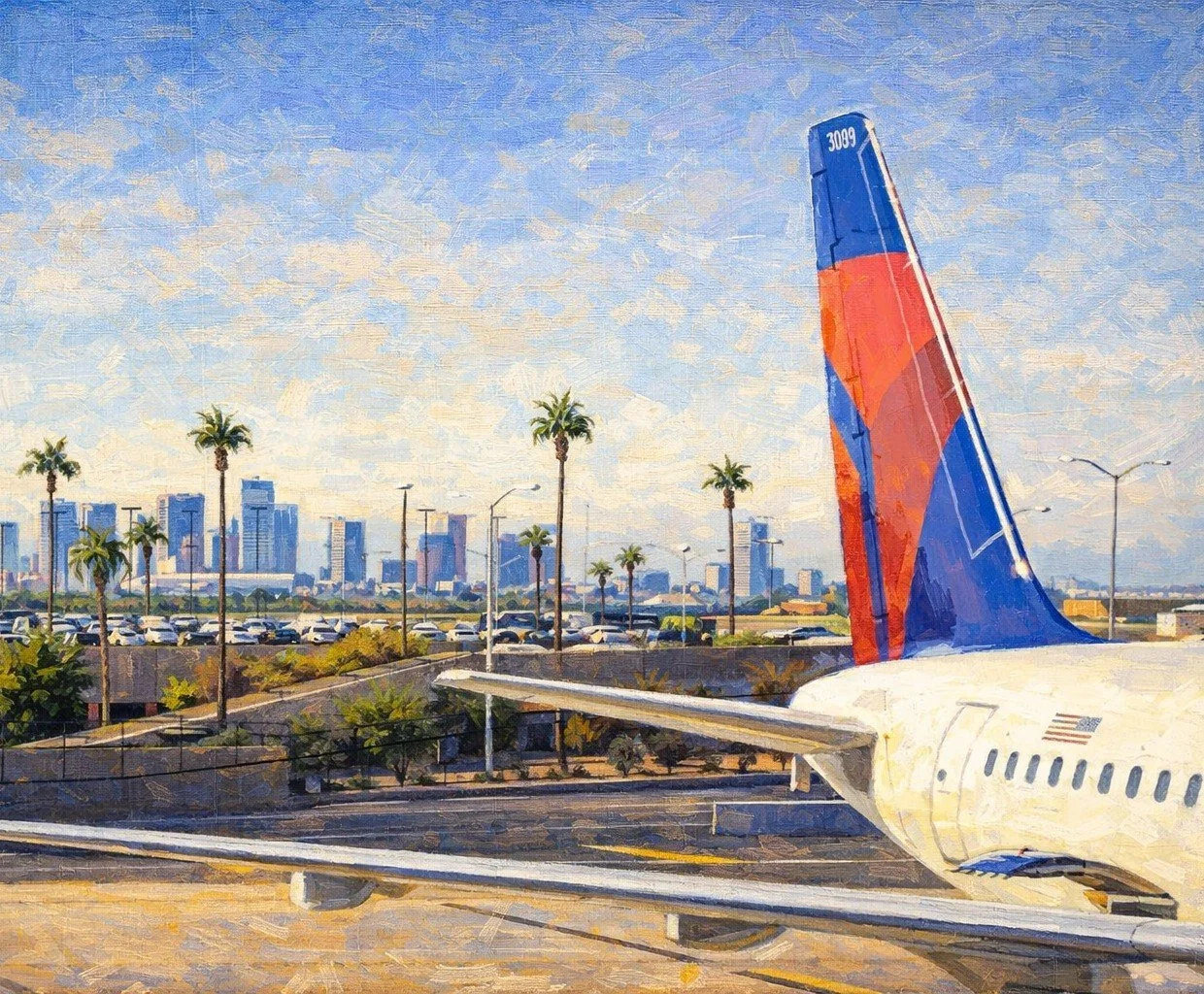
Welcome to My Valley
They’ve Clearly Never Been to My Valley
The largest plane I ever flew on was a Lockheed L-1011 TriStar.
Twice, actually. Once from Jacksonville to San Francisco, and another time from Hartsfield–Atlanta to Seattle.
I remember staring out the window in complete disbelief. Even as a younger man, I understood that aircraft was absolutely enormous. On the ground it looked like a skyscraper laid on its side. It was nothing but metal, seats, luggage, fuel, machinery, and people. Thousands and thousands of pounds of dead weight. And yet somehow it accelerated down a runway and simply left the earth.
Even now, I don’t fully understand how something that massive becomes airborne. I’ve heard the explanations about lift, thrust, drag, and aerodynamics, and I nod politely when people explain it to me. Then I watch a plane take off and think to myself that it still feels like sorcery.
Maybe I was never just fascinated by airplanes. Maybe I was fascinated by leaving.
To this day, one of the strongest scent memories I have is jet fuel. Some people associate home with fresh-cut grass, their grandmother’s kitchen, or the perfume their mother wore before church. For me, it’s jet fuel. One deep breath instantly transports me to Hartsfield–Atlanta or Phoenix Sky Harbor.
In Atlanta, the smell always feels stronger, probably because that airport is so enormous. It’s basically its own city. There is always movement: escalators humming, suitcases rolling across tile floors, flight announcements echoing overhead, reunions happening at gates, hurried goodbyes unfolding near security checkpoints. I love all of it.
When I fly west, I leave from Golden Triangle Regional Airport on the first flight of the morning, usually at six o’clock. That airport feels sleepy at that hour, but by the time I land in Atlanta the world feels fully awake. I usually have a two-and-a-half-hour layover, and I’ve turned that time into ritual: chocolate for the plane from Savannah's Candy Kitchen, breakfast somewhere, coffee at least twice, and if I’m especially ahead of schedule, a ride on the plane train that lasts a little longer than necessary.
I know that last part sounds ridiculous, but I genuinely enjoy watching first-time travelers experience that train. It does not gently ease into motion. It launches. Last summer, a man stepped onboard at the same time I did. He looked to be in his thirties and carried himself with the unmistakable confidence of someone entirely too cool to be inconvenienced. He glanced around and surely noticed everyone else holding onto rails and straps. He chose not to.
The train took off, and so did his dignity.
He hit the floor almost immediately, nearly taking out a kid with a Trolls bookbag. Who knew to cling to one of the poles, by the way.
I never saw him again, but I feel reasonably confident he held onto something the next time he boarded.
Georgia used to feel like home, but I’ve realized it was never really the state itself. It was the people. It was family members who filled houses with laughter during the holidays, voices drifting from kitchens, and ordinary days that somehow felt extraordinary simply because of who was present.
Many of those people have passed on now. Others have chosen not to keep me in their lives. I cherish the first group, and I respect the second.
Mississippi, on the other hand, has never felt like home. Not really. I’ve been here since 2001, and when I first arrived, I truly believed it would be temporary, just a steppingstone toward whatever came next. I simply didn’t realize how long I would be standing on that stone.
But if I’m being honest, I wasn’t in any condition to build a future back then. Alcohol did all of my thinking for me. It made my decisions, shaped my priorities, and swept me along in directions I never would have chosen with a clear mind. There were years when I genuinely didn’t believe I would live long enough to need a long-term plan. That’s difficult to admit, even now.
Today, I’m starting my sixth year of sobriety, and I see things very differently. The shame and blame are gone. The regret is fading. What remains is gratitude and the quiet realization that I am worth taking a chance on.
That realization changed everything.
Maybe I’ll live in Phoenix one day. I believe I will. But even if life takes a different turn, I’ll keep finding my way back. Some places awaken something in you that cannot be put back to sleep.
If you don’t have a key, or at least the courage to knock, doors rarely open. And at the end of the day, no one will ever be able to say I didn’t try. No one will ever be able to say I didn’t pour my entire soul into chasing the life I wanted.
People often write songs, poems, and stories that use valleys as symbols of hardship. They represent grief, struggle, and seasons of life people are forced to endure.
They’ve clearly never been to my valley.
The Valley of the Sun taught me that valleys can also be places of warmth, light, reinvention, and second chances.
And sometimes, if you’re very lucky, they can teach you how to come home.
My valley even has its own harbor.